
KNOW BEFORE YOU VOTE
November Ballot Initiatives Voter Guide
The Freedom Principle MO – Missouri First PAC has reviewed the four constitutional amendments, one proposition and retention of the Missouri Supreme Court on the November general-election ballot. The analysis is based on our reading of the measures and outside research to provide Missouri voters with information and recommendations for voting on November 3rd, 2026 ballot.
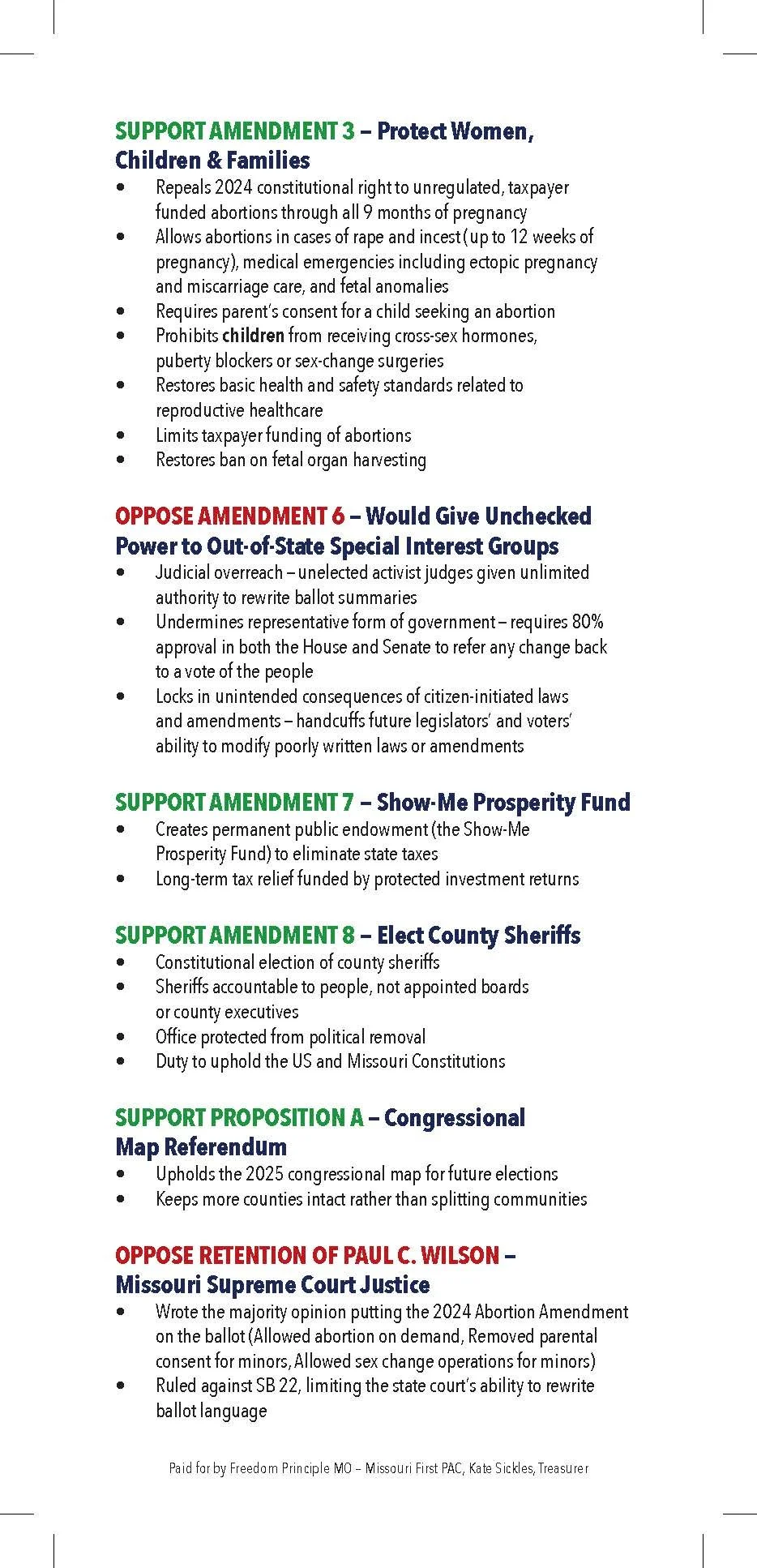
SUPPORT AMENDMENT 3 — Protect Women, Children & Families
Repeals 2024 constitutional right to unregulated, taxpayer funded abortions through all 9 months of pregnancy
Allows abortions in cases of rape and incest (up to 12 weeks of pregnancy), medical emergencies including ectopic pregnancy and miscarriage care, and fetal anomalies
Requires parent’s consent for a child seeking an abortion
Prohibits children from receiving cross-sex hormones, puberty blockers or sex-change surgeries
Restores basic health and safety standards related to reproductive healthcare
Limits taxpayer funding of abortions
Restores ban on fetal organ harvesting
OPPOSE AMENDMENT 6 — Would Give Unchecked Power to Out-of-State Special Interest Groups
Judicial overreach — unelected activist judges given unlimited authority to rewrite ballot summaries
Undermines representative form of government — requires 80% approval in both the House and Senate to refer any change back to a vote of the people
Locks in unintended consequences of citizen-initiated laws and amendments — handcuffs future legislators’ and voters’ ability to modify poorly written laws or amendments
SUPPORT AMENDMENT 7 — Show-Me Prosperity Fund
Creates permanent public endowment (the Show-Me Prosperity Fund) to eliminate state taxes
Long-term tax relief funded by protected investment returns
SUPPORT AMENDMENT 8 — Elect County Sheriffs
Constitutional election of county sheriffs
Sheriffs accountable to people, not appointed boards or county executives
Office protected from political removal
Duty to uphold the US and Missouri Constitutions
SUPPORT PROPOSITION A — Congressional Map Referendum
Upholds the 2025 congressional map for future elections
Keeps more counties intact rather than splitting communities
OPPOSE RETENTION OF PAUL C. WILSON —
Missouri Supreme Court Justice
Wrote the majority opinion putting the 2024 Abortion Amendment on the ballot (Allowed abortion on demand, Removed parental consent for minors, Allowed sex change operations for minors)
Ruled against SB 22, limiting the state court’s ability to rewrite ballot language
Help distribute our Know Before You Vote during early voting. 30% of Missourians will be early voting beginning on Tuesday, October 20th. We need to get our information to these voters to help sway the TV commercials being against our issues.
If you can help work an early voting poll, please complete the form and we will send you some of our Know Before You Vote - Voter’s Guides.