

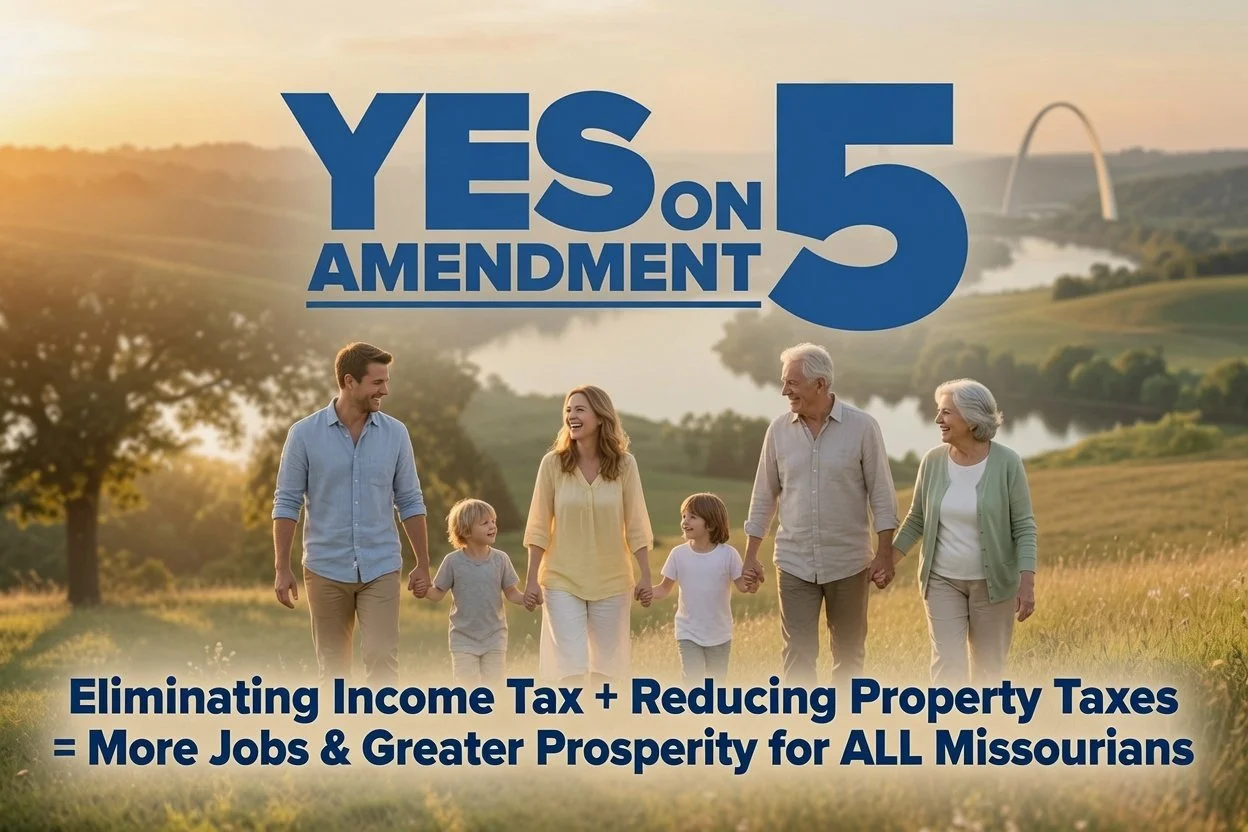
Amendment 5: Building a Missouri Where Families Thrive and Jobs Multiply
Missouri stands at a crossroads. For too long, our state has lagged behind neighbors that chose better tax policies. Amendment 5—the constitutional amendment that phases out and permanently bans the individual income tax—offers a clear, responsible path to reverse that trend. It would make Missouri a place where parents can raise children with greater opportunity, where entrepreneurs create jobs, and where hard work is rewarded rather than penalized.
Missouri stands at a crossroads. For too long, our state has lagged behind neighbors that chose better tax policies. Amendment 5—the constitutional amendment that phases out and permanently bans the individual income tax—offers a clear, responsible path to reverse that trend. It would make Missouri a place where parents can raise children with greater opportunity, where entrepreneurs create jobs, and where hard work is rewarded rather than penalized. The choice before voters is whether Missouri continues to lose its next generation of workers and families or finally adopts the competitive tax structure that has driven growth in states like Tennessee, Texas, and Florida.
Consider the tale of two states. As recently as 1998, Missouri and Tennessee had roughly the same population. Missouri’s median income was about 18 percent higher. Today the picture is reversed. Tennessee has attracted nearly 1.2 million net domestic migrants since then—about nine times Missouri’s gain. Tennessee now has more than a million additional residents and a GDP roughly 25 percent larger. In the 2010s, Missouri even experienced net out-migration. Tennessee’s edge came from competitive policies, including the full repeal of its remaining income taxes on interest, dividends, and inheritance, combined with low property-tax burdens. Missouri, by contrast, long maintained a progressive income tax that, when combined with local add-ons in Kansas City and St. Louis, reached 7 percent for many residents. The results speak for themselves: people and capital have voted with their feet.
The urgency is clearer still when we examine who is leaving. IRS migration data shows 34 percent of young adults ages 25 to 35 are moving out of the state, along with 20 percent of families with young children. Moderate-income earners in the $25,000 to $50,000 range and younger cohorts are the most likely to relocate. Missouri has 6.2 million residents, yet only about 2.8 million pay taxes. This imbalance and the potential loss of a future workforce threaten the state’s economy in profound ways.
A recent University of Missouri Extension study, Missouri Economy Indicators: Young Workers, Ages 16 to 24 (July 13, 2026), documents the early stages of the problem. Missouri’s young labor force aged 16 to 24 has already declined 2.8 percent over the past decade, leaving 21,000 fewer potential youth workers. Youth continue to participate in the labor market at rates above the national average, yet labor shortages are projected to worsen. Nonmetro counties depend more heavily on younger workers than metro areas. In rural manufacturing and construction, the share of youth employment runs three to five percentage points higher. Businesses facing persistent vacancies may invest in labor-saving technology, relocate to larger labor markets, or simply close. Losing the next generation of workers, parents, and taxpayers is not a distant risk—it is already underway and directly undermines Missouri’s long-term prosperity.
For the last 12 years, the Missouri Legislature has already been eliminating the income tax the responsible way, by slowly reducing the rate based on economic growth. In 2014, Senate Bill 509 introduced revenue triggers and cut the top rate from 6 percent to 5.5 percent, the first significant reduction since 1921. Those reductions have continued only when actual revenues supported them, bringing the top rate down to 4.7 percent, a cut of more than a full percentage point—while state general revenues continued to grow substantially even after accounting for inflation. Amendment 5 is the same proven approach, simply placed at an accelerated pace and locked in the Missouri Constitution. Instead of taking another 30 to 40 years to finish the job at the current gradual pace, Amendment 5 will allow Missouri to eliminate the income tax in considerably less time.
That speed matters because surrounding states are already reimagining their tax structures. Kentucky expanded its sales-tax base and systematically reduced its income-tax rate from 5 percent to 3.5 percent. Mississippi and Oklahoma have legislated concrete paths to zero through revenue-based triggers. Tennessee, Texas, and Florida already have no personal income tax and have become magnets for families, jobs, and capital. Missouri cannot afford to stay on the slow track while our neighbors pull further ahead—and while our own young adults and families continue to leave.
Economic research consistently shows why this difference matters. Income taxes are among the most damaging forms of taxation because they directly tax work, saving, investment, and entrepreneurship. They create a higher excess burden—deadweight loss—than sales or property taxes. Cross-country and state-level studies repeatedly find that shifting the tax burden from income toward consumption and property taxes raises long-run GDP per capita.
A recent Council of Economic Advisers analysis estimates that phasing out Missouri’s income tax and replacing it with a broader sales-tax base would raise the state’s GDP by 0.6 to 1.0 percent (roughly $2.8 billion to $4.8 billion), increase average wages by about $2,700 to $2,900, attract hundreds of additional high-income taxpayers, and boost new business startups by 12 to 14 percent. Higher wages and more job opportunities mean parents can provide more for their children. Removing the tax penalty on work and investment encourages saving and capital formation, which raise living standards over time. Shifting toward consumption taxation also reduces the bias against families who save for education, homeownership, or retirement.
Critics worry about legislative overreach or lost school funding. Amendment 5 answers those concerns with strong, permanent guardrails written into the Missouri Constitution itself. The phase-out is mandatory and one-directional. The General Assembly “shall” enact legislation that reduces the top individual income-tax rate based on revenue growth until the tax is eliminated. Once eliminated, the Constitution prohibits any future state individual income tax. Any expansion of the sales-and-use tax base is tightly constrained: it may occur only for the explicit purpose of reducing and eliminating the income tax and reducing local taxes. New sales-tax revenue must be offset in the same bill by income-tax cuts of at least substantially equal size. Local governments that receive extra sales-tax revenue are required to reduce other taxes by a substantially equal amount. School funding is explicitly protected: under no circumstances may any political subdivision reduce funding to public schools as part of these offsets.
The amendment preserves the core taxpayer protections of the Hancock Amendment. It creates only a narrow, temporary, purpose-specific exemption from one procedural provision so the initial revenue-neutral transition can occur without artificial barriers. The original 1980 Hancock revenue ceiling and automatic taxpayer refund rules remain fully intact. After a five-year window, the full force of the procedural safeguard returns. The process relies on the same revenue-growth triggers that have already worked for 12 years. Even without base expansion, the income-tax rate will continue to ratchet downward as the economy grows until it reaches zero.
These guardrails ensure the reform cannot become a net tax increase or a blank check for larger government. They force tax relief, protect schools, open the door to property-tax reductions at the local level, and keep Missouri’s hard-won limits on government growth firmly in place.
Missouri has already proven that revenue-triggered income-tax cuts work. Amendment 5 finishes the job faster, puts the phase-out beyond the reach of future political whims, and lets Missouri compete head-to-head with the surrounding states that are already returning money and control to their taxpayers. The alternative is continued out-migration of the young adults, families with children, and moderate-income workers who form the backbone of our future workforce and tax base. Raising a family and building a business in Missouri should not require watching opportunity migrate elsewhere. Amendment 5 gives voters the power to change that trajectory. Vote yes on Amendment 5.

Amendment 4: The Election Integrity Reform Missouri Needs
Protecting Missouri’s Constitution and the Integrity of Our Elections
Today, Missouri faces the greatest election integrity issue of our time. We elect representatives and senators to speak for us in Jefferson City. Yet Progressives and corporate special interest groups are bypassing the legislature entirely. They use the citizen initiative petition process to embed permanent protections for themselves in our Constitution, with long-term negative consequences for Missourians’ rights and freedoms.
This isn’t democracy. It is stealing your vote and suppressing the will of the people. A handful of urban centers and well-funded outsiders override the rest of the state every cycle.
That is the core problem Amendment 4 confronts. Missouri is a representative republic. We choose lawmakers to deliberate, weigh competing interests, and answer to voters every two or four years. The current initiative process short-circuits that system. Since 2002, more than 300 petitions have been filed; nearly three-quarters sought to rewrite the Constitution itself. Democrat-backed constitutional measures have succeeded at a 60 percent rate once they reached the ballot. Republican efforts have produced none. Meanwhile, foreign and out-of-state money has poured in — more than $10 million from the Sixteen Thirty Fund, backed by Swiss billionaire Hansjörg Wyss, for Amendment 3 alone in 2024, and millions more from other national networks.
The geographic distortion is just as serious. In 2024, Amendment 3 passed largely on the strength of St. Louis and Kansas City. Only eight of Missouri’s 114 counties supported it. Rural voters who rejected the measure still found themselves bound by a permanent constitutional change. When a few densely populated areas and well-funded campaigns can rewrite the state’s foundational document, the votes of the rest of Missouri are effectively diluted.
We have heard, particularly on social media, that the legislature should be held to the same standard as citizen initiatives. Amendment 4 moves the process closer to equality — and does so for good reason. For an out-of-state billionaire to amend our Constitution today, they need only win one election. Their petitions are not constitutionally vetted. There is no real public comment period. They alone determine the ballot language, including what critical information is left off. Just look at Amendment 3 in 2024: the ballot language omitted any mention of gender-transition procedures for children or the removal of parental consent for minors. Voters were asked to approve far more than the wording on the ballot disclosed.
The legislative path is entirely different. Any constitutional amendment proposed by the General Assembly must first be constitutionally vetted before it can even be filed. It must undergo public testimony in both the House and the Senate. It must survive vigorous debate and earn the support of a broad range of elected officials from across the state. Only then is it placed on the ballot — and even then, the legislature cannot enact any constitutional amendment without the final approval of the voters themselves. Amendment 4 raises the citizen initiative process to a comparable level of seriousness and scrutiny for changes to our foundational document. That is not an attack on the people’s voice. It is a recognition that rewriting the Constitution should never be easier for well-funded outsiders than for the representatives Missourians actually elect.
John Locke, whose ideas shaped the American founding, offers a clear framework for understanding why this distinction matters. Locke was deeply skeptical of heavy reliance on direct popular action once a government had been established. He viewed frequent citizen initiatives — especially those driven by well-funded external interests — as resembling the kind of arbitrary, passion-driven power he distrusted. Such mechanisms bypass the deliberative legislative process he considered foundational to legitimate government. Consent, once given to form a commonwealth, is properly expressed through representative institutions capable of reasoned debate and long-term judgment, not through repeated appeals to temporary majorities.
Locke also insisted on accountability through elections. If the people dislike the legislature’s actions, the proper remedy is to vote its members out of office — not to undermine the representative system itself. Constant recourse to initiative petitions that rewrite the Constitution weakens that system and invites the very instability Locke sought to prevent. A republic functions properly when the people hold their representatives responsible at regular intervals, rather than treating the Constitution as an open invitation for permanent policy capture.
Above all, Locke prioritized the greater good and the protection of the commonwealth. He would judge political arrangements by whether they best secure natural rights and public welfare over time. By that standard, Amendment 4 is a reasonable and necessary step. It restores balance and prevents one-sided “constitutional fiat” that weakens the representative republic in favor of direct-democracy tools more susceptible to temporary majorities and outside influence. The result of the current process has been a constitution increasingly shaped by forces that answer to no Missouri voter and that lock in policies difficult to correct once embedded.
Amendment 4 addresses these failures without abolishing citizen input. It requires citizen-initiated constitutional amendments to win a simple majority in each of the eight congressional districts, ensuring broader geographic consent. Statutory initiatives and referendums remain unchanged. Foreign contributions are banned. Signature fraud is criminalized. Voters receive clearer ballot language. The legislature keeps its authority to revise ordinary statutes. These are not barriers to democracy; they are protections against the permanent capture of the Constitution by temporary majorities and outside interests.
True election integrity means more than secure ballots on Election Day. It means ensuring that the system of representation we elect is not routinely nullified by processes designed to embed one-sided outcomes permanently. Missourians elect legislators to speak for them. They should not have their constitutional future rewritten by professional signature gatherers and national funding networks. Amendment 4 is a necessary step to restore the integrity of that relationship. Voters should approve it.
Byron Keelin, President
Freedom Principle MO