


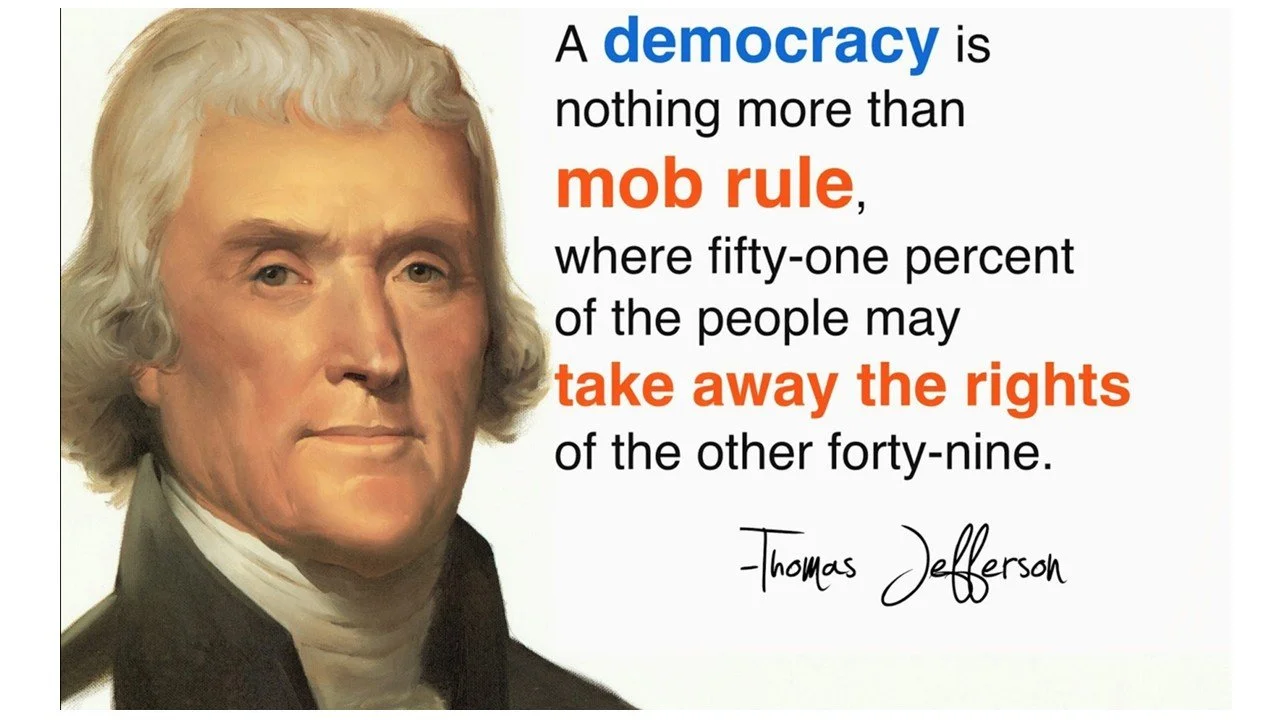
Tyranny of the Majority is a problem that must be considered with the adoption of any new public policy
Don’t Let Radical Agendas Rewrite Missouri’s Future.
Amendment 6 could give special interests more power over our laws and make their agenda harder to undo.

Out-of-state special interest groups want to rewrite Missouri’s constitution, and Amendment 6 will help them do it. By giving radical leftists in St. Louis and Kansas City more power, Amendment 6 could allow those two cities to drive decisions that affect our entire state. Communities across Missouri deserve a say in those decisions.
Amendment 6 would also make measures passed through citizen petitions harder for our elected lawmakers to change or repeal, even when problems become clear. That could leave Missourians living with consequences our representatives have limited ability to address. Download the fact sheet to understand what Amendment 6 would change and why we’re urging Missourians to vote No on November 3rd!
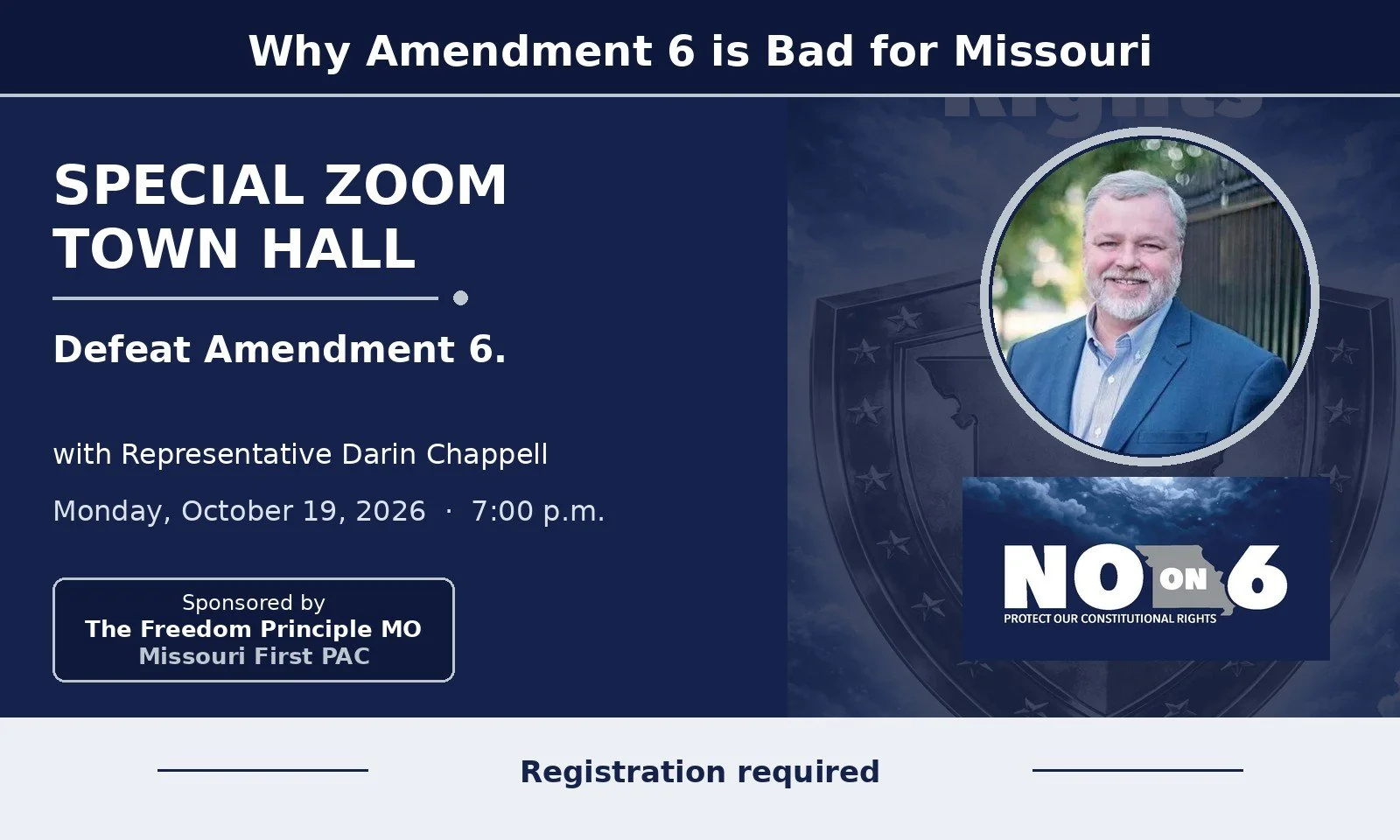
Special Zoom Townhall on Why Amendment 6 is Bad for Missouri
Special Zoom Town Hall with Representative Darin Chappell Monday, October 19, 2026 · 7:00 p.m. Registration required
Amendment 6 would lock the initiative-petition process into the Missouri Constitution and handcuff the General Assembly.
A yes vote would:
Declare initiative and referendum a “fundamental right,” so related laws face strict scrutiny in court
Stop the legislature from raising signature thresholds or requiring more than a simple majority
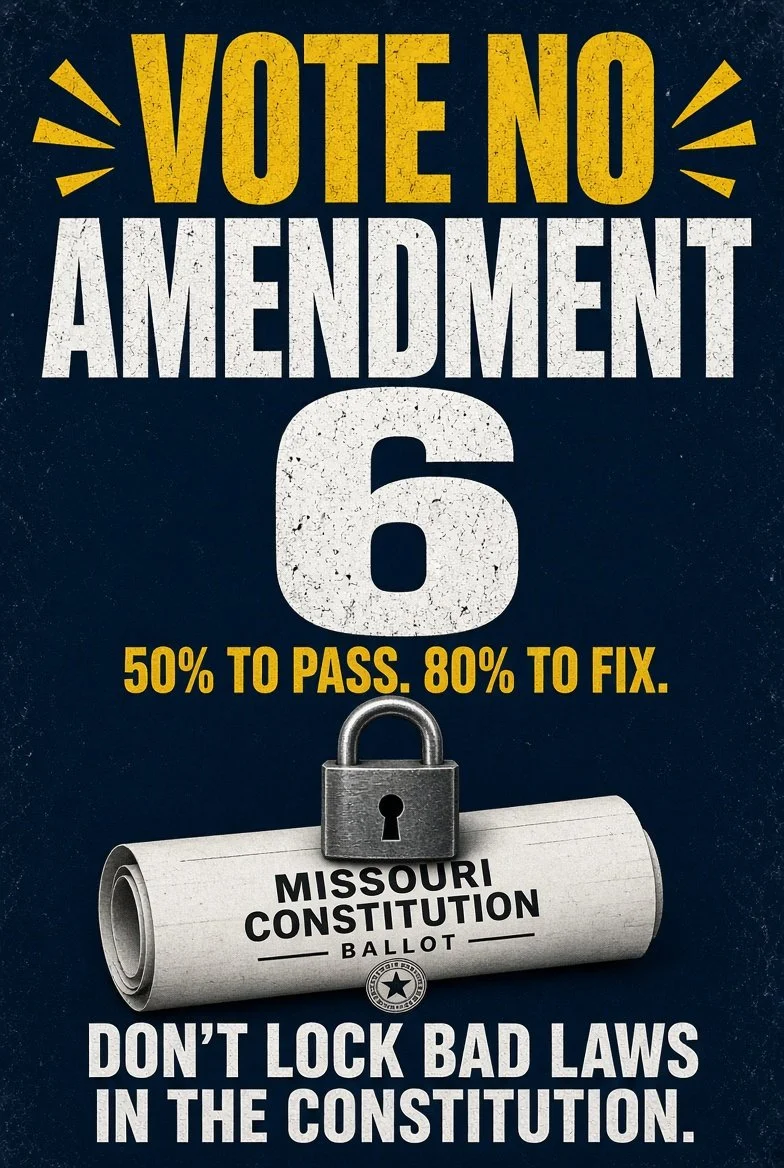
Block changes to a voter-passed law unless 80 percent of both the House and Senate first send the change back to the ballot
Let courts rewrite ballot summaries
Freeze today’s signature rules and simple-majority approval
That 80 percent bar is nearly impossible to clear. A poorly written or costly measure could not be fixed even when lawmakers broadly agree it needs repair. One well-funded campaign could pass a law by a simple majority and wall it off from the representatives Missourians elect.
Join Representative Chappell to walk through the ballot language and why Amendment 6 should be defeated on November 3.
Monday, October 19, 2026, at 7:00 p.m. Zoom town hall · Registration required.
Sponsored by The Freedom Principle MO – Missouri First PAC
Download Our Vote NO on Amendment 6 Materials and Share with Your Friends and Family


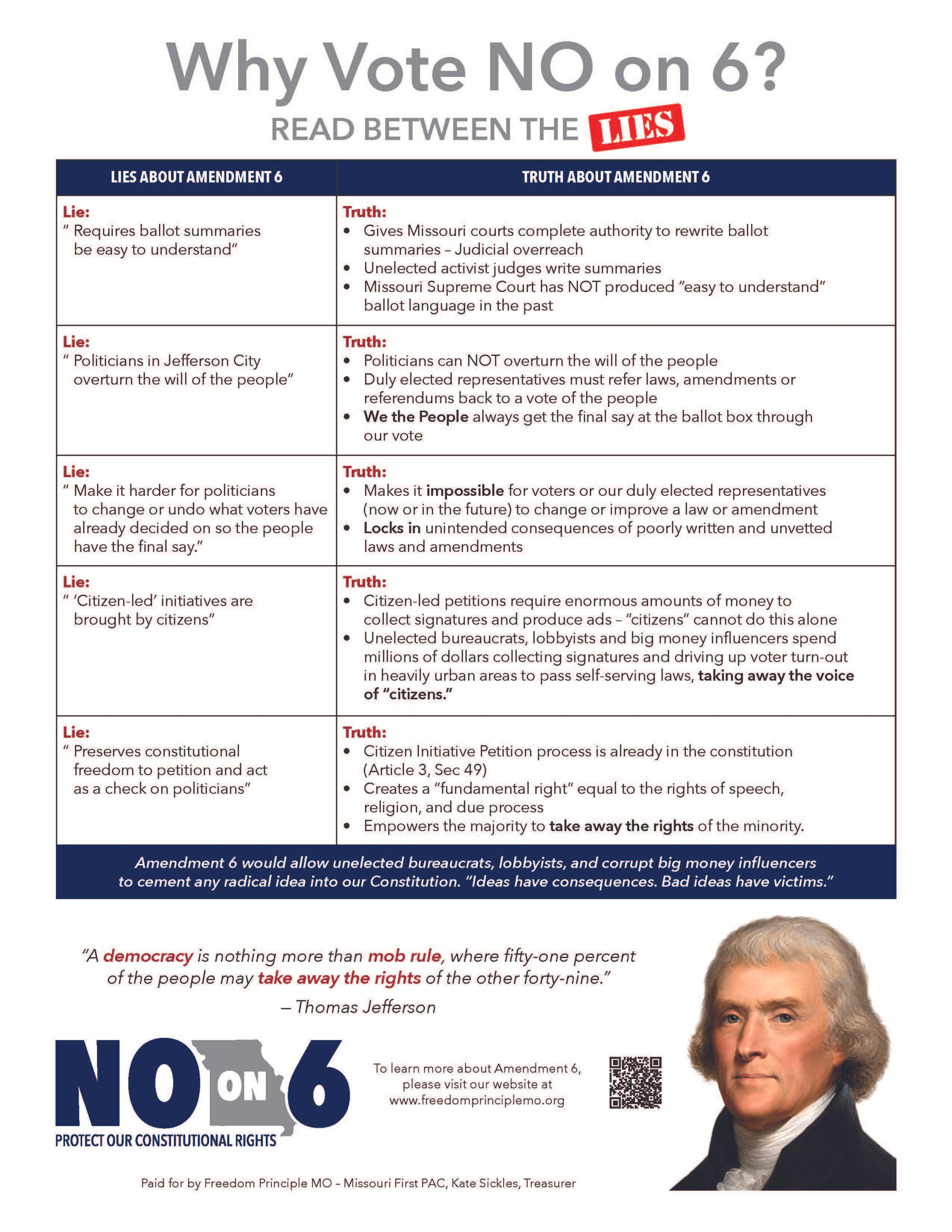
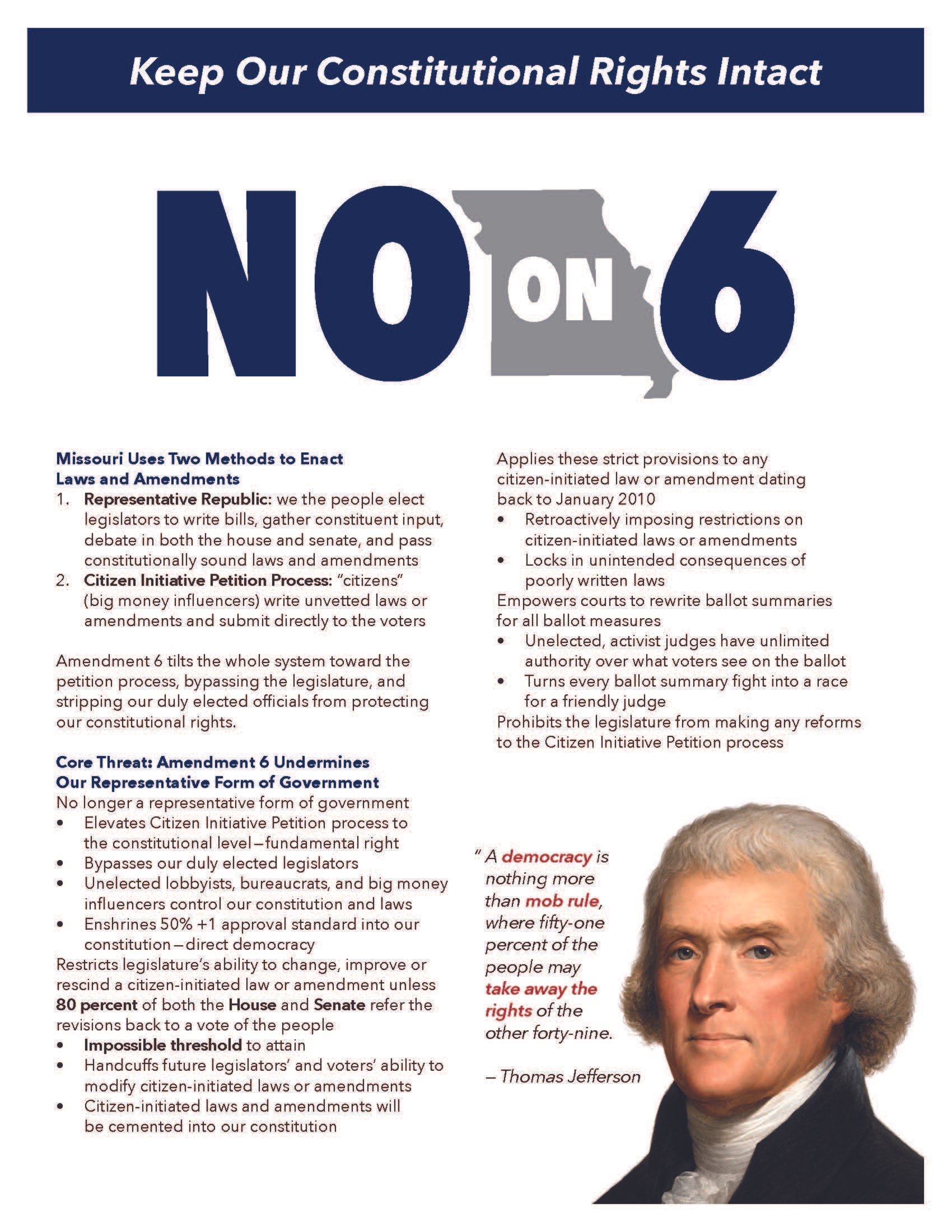

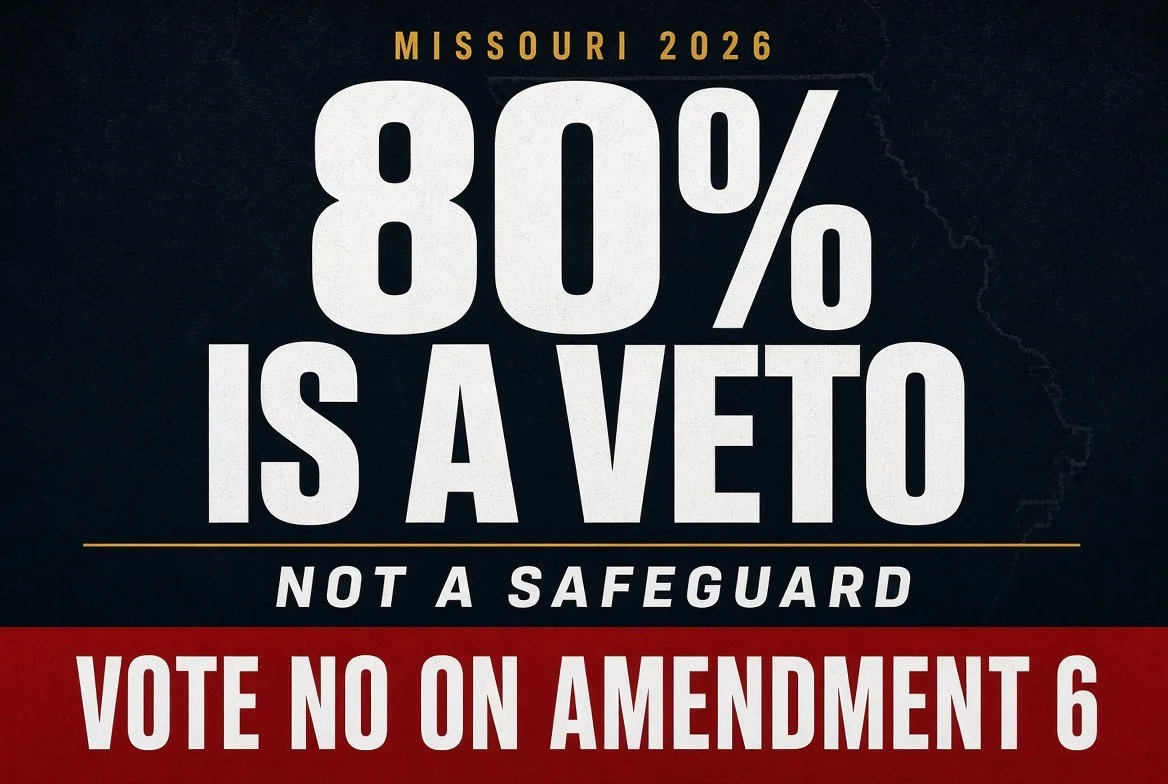
VOTE NO ON AMENDMENT 6
Don’t Let Lobbyists, Corrupt Corporations, and Bureaucrats Take Our Freedom
Freedom Principle Appearance on The Steve Deace Show (October 8, 2026) to discuss Amendment 6 and Amendment 3.

Why Amendment 6 Must Be Defeated
The Progressives want to gaslight you into believing Amendment 6 is about “protecting voters’ rights.” That is the opposite of what it does. It takes the vote you cast for representatives, and the power of future voters to correct bad policy, and locks both behind an 80 percent wall. One election becomes a gag order on every election that follows.
Missouri uses two methods to enact laws and amendments:
Representative Republic: we the people elect legislators to write bills, gather constituent input, debate in both the house and senate, and pass constitutionally sound laws and amendments
Citizen Initiative Petition Process: “citizens” (special interest groups) write unvetted laws or amendments and submit directly to the voters
Amendment 6 tilts the whole system toward the petition process, bypassing the legislature, and stripping our duly elected officials from protecting our constitutional rights.
The Core Threat: Amendment 6 Undermines Our Representative Form of Government
Hands lobbyists, bureaucrats, and special interest groups control over our constitution and laws
Bypasses our duly elected legislators
Undermines our representative form of government
Restricts legislature’s ability to change, improve or rescind a citizen-initiated law or amendment
unless 80 percent of both the House and Senate refer the revisions back to a vote of the people
Impossible threshold to attain
Citizen-initiated laws and amendments will be cemented into our constitution
Handcuffs future voters by denying ability to modify any citizen-initiated laws or amendments
Applies these strict standards to any citizen-initiated law or amendment dating back to Jan. 2010
Retroactively imposing restrictions on citizen-initiated laws or amendments from 16 years ago
Locks in unintended consequences of poorly written laws
Empowers courts to rewrite ballot summaries for all ballot measures
Unelected, activist judges have unlimited authority over what voters see on the ballot
Turns every ballot summary fight into a race for a friendly judge
Prohibits the legislature from making any reforms to the Citizen Initiative Petition process
No changes allowed to signature gathering process or thresholds
Enshrines 50% +1 approval standard into constitution
What the Official Ballot Title Says—and How it Silences Your Vote
The title certified September 9, 2025, and ordered onto the November 3, 2026 ballot asks whether the Constitution should be amended to:
expand the initiative and referendum petition process by making it a fundamental right;
allow courts to revise ballot summaries through lawsuits;
prohibit the legislature from weakening initiative or referendum powers;
prohibit the legislature from changing or repealing laws enacted through the initiative process, or passing laws similar to those rejected by referendum, without approval from at least 80% of both chambers; and
preserve existing majority vote and signature requirements for initiative and referendum petitions?
The title estimates “no costs or savings.” It does not tell voters that the 80 percent lock looks back to 2010, that it creates two different amendment processes inside one Constitution, or that it constitutionalizes judicial rewriting of ballot language.
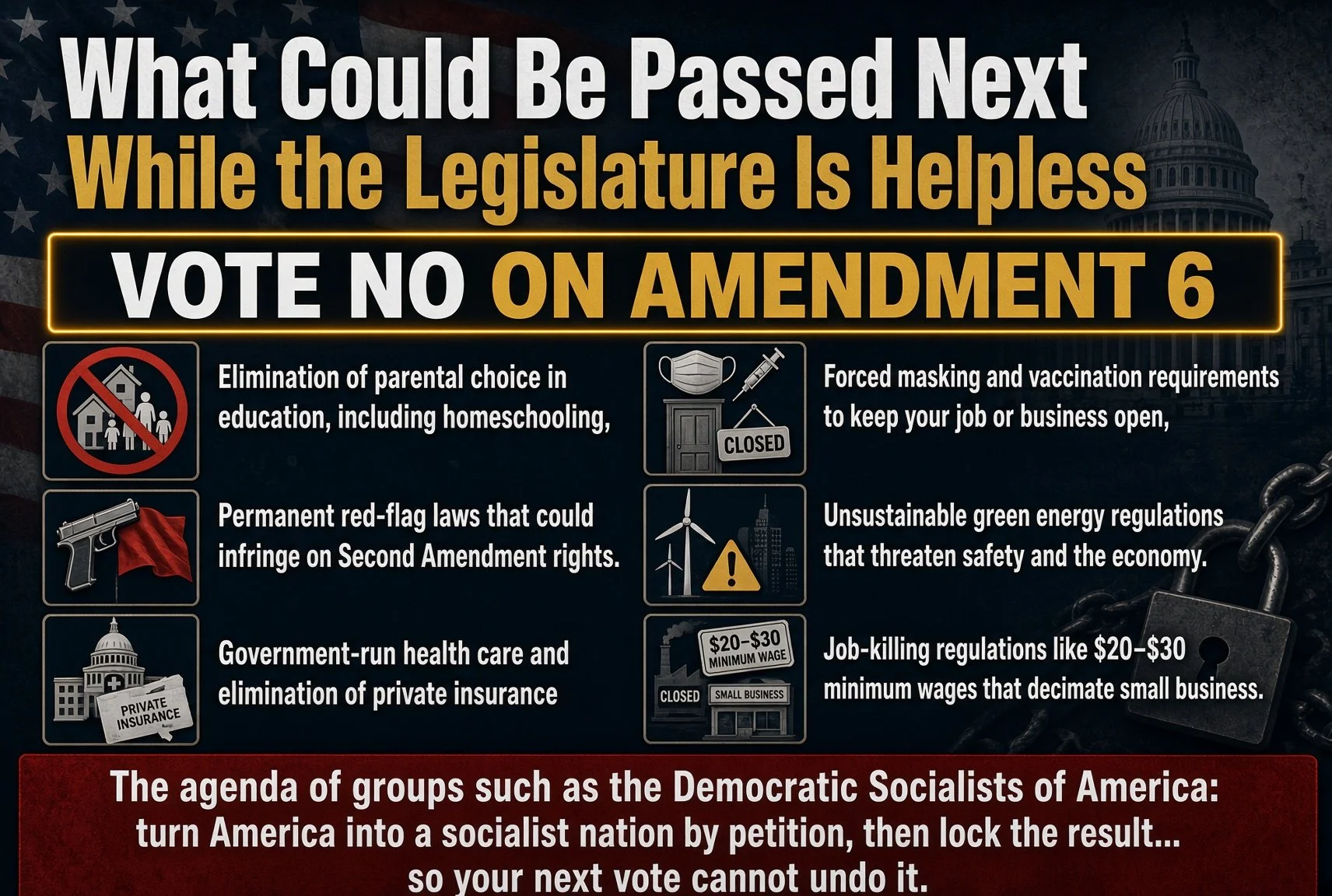
What Could Be Passed Next While the Legislature Is Helpless
The consequences of never being able to fix past petitions are severe. Think about what could be passed—either as a constitutional amendment or by statutory petition—while the people you elect cannot protect your rights:
Elimination of parental choice in education, including the elimination of homeschooling.
Permanent red-flag laws that could infringe on your Second Amendment rights.
Government-run health care and the elimination of private insurance coverage.
Forced masking and vaccination requirements to keep your job or keep your business open.
Unsustainable green energy regulations that threaten our safety and our economy.
Job-killing regulations, like $20 to $30 minimum wages, that would decimate small business and force small manufacturers out of state.
This may sound extreme. They are the agenda of groups such as the Democratic Socialists of America: turn America into a socialist nation by petition, then lock the result so your next vote cannot undo it.
A Circuit Court Judge Already Said Amendment 6 Violates the Missouri and U.S. Constitution
In August 2026, Cole County Circuit Judge Daniel R. Green ruled in Harris v. Hoskins that Initiative Petition 2026-106—the measure now labeled Amendment 6, pushed by Respect MO Voters—violates the Missouri Constitution and the United States Constitution.
Judge Green named Missouri Constitution Article III, Section 50; Article I, Section 3; and U.S. Constitution Article IV, Section 4 (Guarantee Clause). He found the petition is not a single reform. It rewrites petition rules, court review of ballot language, legislative power, and how past voter measures can be changed—then asks for one Yes.
He also held that the 80 percent lock violates the anti-entrenchment principle: one generation of voters cannot handcuff the next by making laws nearly impossible to change or repeal. Green wrote that the measure bars the General Assembly from changing citizen-initiated laws or even referring to a similar question to the people unless each chamber first hits an unprecedented 80 percent vote.
The Missouri Supreme Court later ordered the measure onto the November ballot on procedural grounds tied to the Secretary of State’s certificate. The Court rejected pre-election single-subject and single-article objections and held several arguments about what could happen if the amendment passes are not ripe before the election. Placement on the ballot does not erase what Judge Green mapped in the text. If Amendment 6 becomes part of the Constitution, the lock he described is the law.
What Judge Green Warned Voters Are Not Being Told
One vote, many subjects. It rewrites petition rules, court review of ballot language, legislative power, and how past voter measures can be changed—then asks for one Yes.
A silent lock on 2010–forward policy. The look-back would shield years of prior initiative and referendum outcomes—Medicaid expansion, marijuana, sports betting, Clean Missouri, abortion policy, and more—without clearly telling voters what is being locked in.
80 percent to reopen a question. Lawmakers could not change a covered citizen-initiated law or amendment—or even send a similar question back to voters—unless each chamber hits an 80 percent vote.
It binds the next generation. Today’s majority would make it unusually hard for future legislatures or future voters to reconsider those policies.

Who is Behind Amendment 6 - Follow the Network
RespectMOVoters.org markets a "volunteer-led, cross-partisan" campaign.
Respect MO Voters Not A “Grassroots” Organization. It Is a Show Me Integrity Project
KQ2 reported the campaign as "an initiative by the group Show Me Integrity." Missouri Ethics Commission and IRS records reviewed by Liberty Alliance USA tie Respect Missouri Voters PAC to Show Me Integrity, the Show Me Integrity Education Fund, and the same University City address (725 Kingsland Avenue, Suite 100). The PAC has paid the Education Fund for campaign work. Show Me Integrity was also an early cash donor. This is not a spontaneous neighborhood committee. It is the latest vehicle of a professional ballot-measure network.
Benjamin Singer — The Operative, Not a Bystander
RespectMOVoters.org lists Benjamin Singer as Co-Founder and Campaign Director. In his own bylines he is CEO of Show Me Integrity, the 501(c)(4), and principal officer of the related 501(c)(3) Education Fund. That is the same person running the "grassroots" amendment and the professional reform shop that built it.
2018: Communications director for Clean Missouri (Amendment 1) — the statewide redistricting / ethics rewrite that professionalized Missouri petition politics.
2020: Helped lead St. Louis Proposition D — nonpartisan city elections with an approval-voting primary (vote for as many candidates as you "approve") and a top-two runoff. Approval voting is the close cousin of ranked-choice / alternative voting systems Missourians later rejected statewide.
2022: Proposition R in St. Louis — aldermanic conflict-of-interest and redistricting rules, again via the Show Me Integrity model.
2024: Show Me Integrity opposed Amendment 7, the statewide ban on ranked-choice voting (Missourians passed the ban roughly 68 to 32). Singer called Amendment 7 a "trick measure" and pledged to "reverse Amendment 7 and bring more accountable elections for ALL Missourians." He also wrote that if voters want ranked-choice voting, approval voting, or open primaries, Amendment 7 takes that choice away — the agenda he is still carrying.
Show Me Integrity fundraising pages have solicited money to "pass approval voting in Missouri" and put "nonpartisan election reform on the ballot." Amendment 6 would make those future election-system petitions far harder for the legislature — or later voters acting through their representatives — to unwind.
Who Is Endorsing the Lock — Read the Coalition
From RespectMOVoters.org and the campaign's own endorsement sheet. This is the political neighborhood that wants an 80% padlock on voter-passed initiatives from 2010 forward:
Show Me Integrity (Singer's own shop)
Missouri National Organization for Women
Missouri NAACP
Veterans for All Voters Metropolitan Congregations United
St. Louis Association of Community Organizations
Missouri Women's Political Caucus
NCJW St. Louis
Missouri Sierra Club
Missouri Coalition for the Environment
Missouri Indivisible Coalition
St. Louis Post-Dispatch
Former House Minority Leader Crystal Quade (D)
Former Secretary of State Jason Kander (D)
